The Claw Agent
The master agent that receives your instructions. It organises what it needs to to achieve the aim of your instructions. It is different to a toolbox and an assistant because you are specifying outcomes, not picking out tools.
TubeClaw AI is a cloud-based YouTube agent that takes a single instruction — typed, spoken, or sent through Telegram — and handles the rest. Scripts, faceless videos, avatars, voiceovers, titles, tags, thumbnails, publishing, comment replies. You describe the outcome. It does the work.
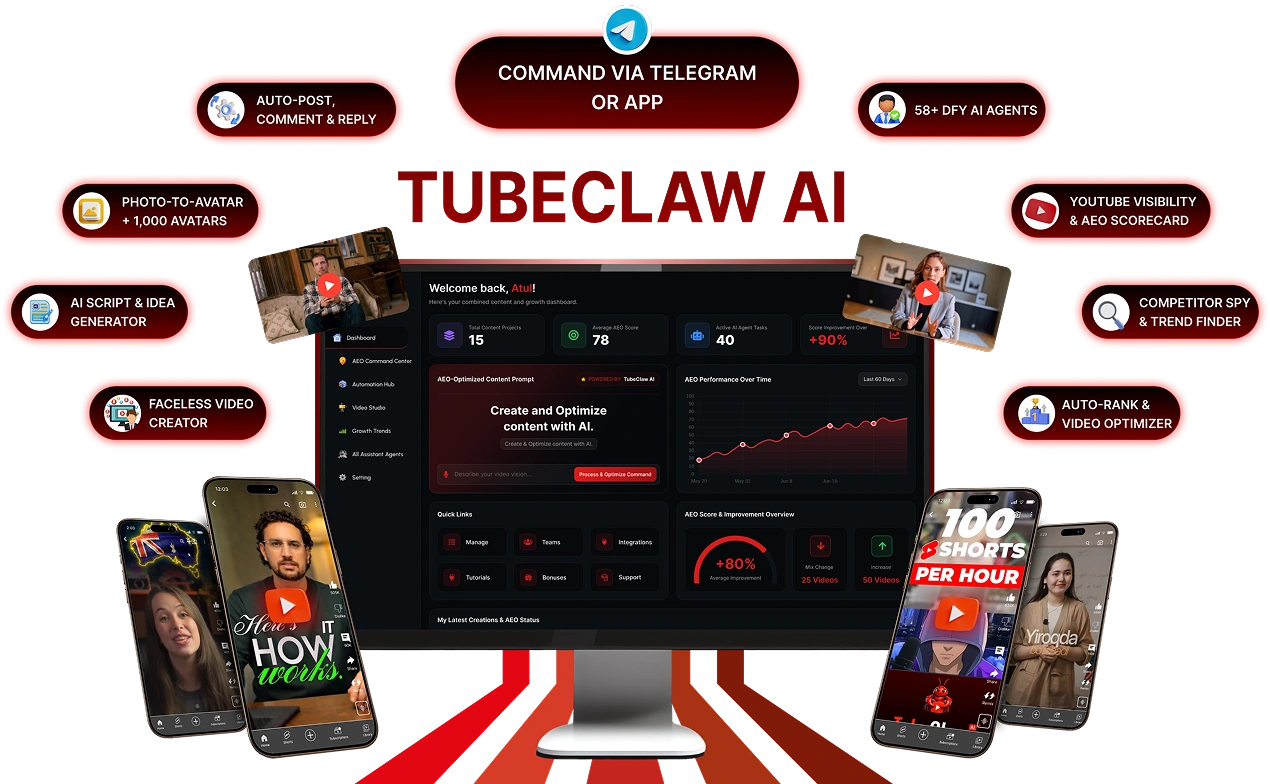
It takes about eight different jobs to handle a YouTube channel fully functionally. Research for ideas. Scriptwriting. Recording or sourcing original footage. Editing. Thumbnail design. Title and tags optimisation. Organising publications in time. Commenting replying. All of these eventually burn out the creator or they have to pay money to the team to do them.
Far more than another AI vid generator, TubeClaw AI represents a fully encompassing growth platform with end-to-end content creation (idea to script, script to faceless video) and optimisation (title and thumbnail). This is completed with publishing, lead generation (if clients, etc. are managed) and comment generation and management.
It is purely cloud-based. Your laptop does not render anything; the work is done on TubeClaw servers, so the feature to use phones and Telegram to issue instructions does actually work. Issue a command from your mobile while on the train commute and there will be a finished-looking video ready for you by the time you arrive home.
An agent that lives above other agents and delegates your instruction. I do not give a thumb up or a tag by telling it what agent is more equipped to delegate than the other - I describe what I wanted to obtain and let it delegate to other agents.
You command it like you would text a person. Write a message on the dashboard, speak into your smartphone or send it a telegram message. This is what truly makes it usable away from your desktop.
Users lacking cameras: Writer takes AI to a full conclusion through single-image controlled avatar and workflow controlled by it, it writes a response and engineers the voice/visual of said avatar that creates a complete uploadable product from a response: a full-fledged content creator, transforming a prompt into a publishable result.
Competitor analysis, trend discovery, a YouTube visibility scorecard and an auto-optimiser you can point at any existing video URL. CREATION WITHOUT DISTRIBUTION IS JUST A HOBBY - this side matters.
Four stages, and you're only genuinely involved in the first and the last. Here's what happens between them.
Want a faceless video on 2026's top 5 budget travel destinations, for 6 minutes, optimized for search? Just say the words - type in the dashboard, speak into the app, send on Telegram. Use plain language naturally, without templates or prompt engineering needed.
Your request will be handled by our servers and forwarded to the specialized agents who cope with the task of each component: script agent for writing, avatar engine with rendering services for displaying, the voice model with its role in narration and SEO agent coping with the researches of words to achieve best exposure for the video. With TubClaw doing work in the cloud, then on client-side machines, a vast array of specialized resources can be and have been put to use for our valued clients.
You get back a complete video in return: visual, avatar with lip-sync and voice-over + keyword-optimised title & description, tag set & thumbnail concept. The visibility scorecard tells you about likelihood of performance of expected asset, before even you publish anything.
You can approve or tweak and release this onto your channel, either immediately or as a schedule. Also, it will comment and reply so engagement continues automatically. Save the workflow, the next video on that channel requires only a line of command.
Nine core modules. Each one replaces a tool you'd otherwise be paying for separately.
The master agent that receives your instructions. It organises what it needs to to achieve the aim of your instructions. It is different to a toolbox and an assistant because you are specifying outcomes, not picking out tools.
Specialist agents pre-loaded with prompts for individual growth tasks — hooks, retention scripting, tag research, channel audits, description writing, comment tone. You pick the agent and give it your topic.
Produces complete videos with no camera, no recording and no editing timeline. Ideal if you want to run channels in niches where nobody expects to see a presenter's face — history, finance, listicles, explainers.
A library covering different ages, demographics and presentation styles, with lip-sync and voice cloning available. You can match a presenter to a niche rather than using the same generic voice on every channel.
Upload a still photo and it becomes a talking presenter with lip-sync and facial movement. Useful for branded channels where you want a consistent face without filming every episode.
Paste any video URL and get a diagnostic on why it is or isn't ranking. It flags the specific weaknesses — weak title keywords, thin description, missing tags — rather than giving you a vague score.
Generates keyword-loaded titles, structured descriptions, precise tag sets and click-worthy thumbnail concepts. Point it at existing underperforming videos and it rewrites the metadata for you.
This tool lets you reverse-engineer the strategies of competing channels currently outperforming your niche competitors, allowing you to mine their keywords and content frameworks. You can use its trend finder feature to capture rising trends before market saturation, something authors grossly underestimate the importance of mastering if they want to win eyeballs.
Scout businesses in a niche or geography whose YouTube presence is weak, then export their details to a spreadsheet for outreach. This is the module that turns TubeClaw from a creator tool into an agency system.
Not the feature list restated — the practical differences users report after the first few weeks.
A faceless video that took most creators 4–6 hours across scripting, sourcing footage, recording and editing comes back in minutes. That's the single biggest change people describe — the bottleneck moves from production to deciding what to make.
Consistency is what YouTube rewards, and it's exactly what breaks first when a human is doing everything manually. Removing the production bottleneck is what makes a genuine daily or three-times-weekly schedule realistic.
A significant share of people who'd be good at YouTube never start because they don't want to be on camera. Avatars and voice cloning remove that barrier entirely — you can build an audience without ever appearing.
Running one channel manually is a job. Running five is impossible. With command-based production, operating several niche channels at once stops being a fantasy and becomes an operational question about niche selection.
The commercial licence plus the lead finder means you can sell channel setup, video production or optimisation as a service. Several users report this being the fastest route to recouping the cost — one client covers it.
Script writer, avatar tool, voice generator, thumbnail designer, keyword research tool, scheduler. Consolidating those into one platform cuts both the monthly spend and the mental overhead of switching between them.
Three accounts from the 1,800+ collected — including the one where expectations needed adjusting. That one's the most useful.
"I'd been sitting on a faceless channel idea for over a year because the editing workload looked unbearable. First week with TubeClaw I published four videos. The avatar quality genuinely surprised me — my brother thought I'd hired someone. The Telegram command thing sounds gimmicky until you use it, then it's the feature you rely on most."
"I run a small marketing agency and the lead finder paid for the whole thing inside two weeks. Found eleven local businesses with dead YouTube channels, pitched four, closed two at $800/month each. The videos we produce for them take about twenty minutes of my time per week now."
"Four stars, and I want to be fair about why. The tool does what it says — but it produces assets, not an audience. My first ten videos got almost no views because I picked a saturated niche. Once I used the competitor spy properly and moved sideways into something less crowded, things changed. It's a production engine, not a strategy."
From purchase to your first published video — and the things that separate people who get results from people who don't.
You get dashboard access immediately after purchase — nothing to install. Connect your YouTube channel through the integrations panel so publishing, scheduling and comment automation can work. Install the mobile app and link Telegram if you want command access away from your desk. Fifteen minutes, once.
A lot of people skip this stage and later end up with regret. Study at least 3-4 channels in your space that already have successful video content, do keyword analysis on their success, review their content framework, consider if the space you wanna compete in is too crowded or not. 20 minutes of research now would save you ten videos that no one would ever view again!
Be specific. "Make a video about dogs" produces something generic. "Create a 7-minute faceless video on the five most common mistakes first-time dog owners make, conversational tone, targeting people who just adopted" produces something usable. The clearer the brief, the less you'll edit afterwards.
Watch the video again. Read the script. Recheck stats, facts + dates/names. It is quicker, it is NOT infallible and any of this information being wrong will be down to your channel to take the rap for. View the product as a (strong!) first draft which you can be proud to publish - after it is passed YOUR review!
Before publishing, run the finished video through the scorecard. It flags weak metadata while you can still fix it. After publishing, come back weekly and run the optimiser on anything underperforming — rewritten titles and descriptions on existing videos often produce more gain than new uploads.
Once your first few videos are working then go ahead and batch-produce and schedule them. Leave auto-comment on to interact with your customer followers and auto-reply and so engage new users and the communication keeps flowing even between videos. This is where the tool stops being something you use and begins being something which runs.
TubeClaw removes the production constraint, which tempts people into publishing enormous volume into crowded niches. That doesn't work. Ten videos in an underserved niche outperform a hundred in a saturated one. Use the trend finder and competitor spy to find gaps before you scale output.
Channel identity matters more than variety. Viewers build familiarity with a presenter and a voice. Rotating through different avatars every video makes a channel feel inconsistent and disposable. Choose a combination that fits your niche and keep it for at least fifty videos.
Retention is decided in the opening seconds, and AI hooks tend toward the generic. Let the agent write the body of the script, then rewrite the hook in your own words. It's two minutes of work per video and it's the highest-leverage edit you can make.
YouTube permits AI-assisted content but has rules about disclosure, and it penalises mass-produced low-value uploads. Add genuine perspective, verify claims, disclose synthetic media where required. The creators getting hurt are the ones treating automation as a licence to publish filler.
One-time payment, no recurring subscription. The bundle is the option worth taking seriously — it's the one that includes the commercial licence.
Pricing shown reflects the current launch offer and may change. Confirm live pricing, tier contents and licence terms on the official order page before purchasing.
Get in, connect a channel, run the competitor spy, produce a few videos and see what the output actually looks like for your niche. If the platform doesn't do what's described here, contact the vendor's support desk within 30 days for a refund. That window is enough to properly test it — use it rather than letting the tool sit unopened.
Get TubeClaw AI Now →How it stacks up against the usual routes to producing YouTube content at volume.
| Feature | TubeClaw AI | Separate AI Tool Stack | Freelance Editors | Doing It Yourself |
|---|---|---|---|---|
| Faceless video creation | ✓ Built in | ⚠ 3–4 tools | ✓ Yes | ⚠ Slow |
| AI avatars & voice cloning | ✓ 1,000+ / 150+ | ⚠ Separate sub | ✗ No | ✗ No |
| Command via chat / Telegram | ✓ Yes | ✗ No | ⚠ Messaging only | ✗ N/A |
| Built-in SEO auto-ranking | ✓ Yes | ⚠ Extra tool | ✗ Rarely | ⚠ Manual |
| Competitor & trend research | ✓ Included | ⚠ Extra tool | ✗ No | ⚠ Manual |
| Client lead sourcing | ✓ Included | ✗ No | ✗ No | ✗ No |
| Cost structure | ✓ One-time | ✗ $80–200/mo | ✗ $300–2k/mo | ⚠ Your time |
| Time per video | ✓ Minutes | ⚠ 1–2 hours | ⚠ 1–3 days | ✗ 4–8 hours |
One instruction. 58+ agents. The finished, optimised, publishable video - all whilst you are doing something else. And with a 30 day guarantee so the only real cost of finding out is the time it takes to try it.
Get TubeClaw AI Now →
The bundle price is a launch offer and the Fast Action bonuses come off the table when it ends. There's a 30-day guarantee behind it — which means the decision costs you nothing but the time to test it properly.
See The Bundle Deal →30-Day Guarantee · Commercial License · One-Time Payment